

Indian Budget 2026: Will Capital Gains Tax Be Reduced? What Investors Can Expect
Union Budget 2026 is around the corner and investors are eagerly waiting for clarity on capital gains tax. Will Capital Gains Tax Be Reduced FM Nirmala Sitharaman reduce LTCG and STCG to boost stock market participation and FII inflows?
Bulls In
1/31/20262 min read

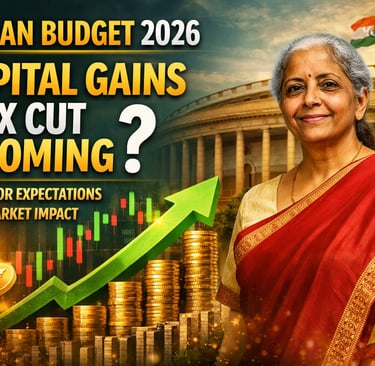
Indian Budget 2026: Will Capital Gains Tax Be Reduced? What Investors Can Expect
As India moves closer to Union Budget 2026, one question is dominating Dalal Street, startup boardrooms, and retail investor communities alike — will Finance Minister Nirmala Sitharaman reduce capital gains tax this year?
With Indian stock markets attracting record participation from retail investors and foreign institutional investors (FIIs) slowly returning, expectations are running high that the government may announce capital gains tax relief to energize long-term investments and deepen market participation.
Let’s decode what investors may realistically expect from Budget 2026 and why a capital gains tax cut could be a strategic masterstroke.
Current Capital Gains Tax Structure in India
At present, investors face:
Short-Term Capital Gains (STCG) on equities: 15%
Long-Term Capital Gains (LTCG) on equities above ₹1 lakh: 10%
Debt mutual funds and other assets attract higher tax rates, especially after recent changes.
While India’s capital gains tax is moderate compared to some global markets, investors argue that frequent policy changes and higher compliance reduce confidence, especially for long-term wealth creators.
Why Capital Gains Tax Reduction Is Being Expected
There are four strong reasons why the market is expecting some relief in Budget 2026:
1️⃣ Boost Long-Term Investing Culture
Lower LTCG tax encourages investors to hold quality stocks longer, reducing speculative trading and market volatility.
2️⃣ Bring Back Foreign Investors (FII Inflows)
FIIs closely track post-tax returns. A friendlier tax regime can revive foreign capital inflows, especially when India competes with markets like Vietnam, Indonesia, and the US.
3️⃣ Support Startup & New-Age Economy
Startup founders, angel investors, and VC funds have been vocal about high exit taxation. Any rationalization here can accelerate innovation funding.
4️⃣ Strong Tax Collections Give Cushion
India’s GST and direct tax collections have remained robust. This gives the government fiscal room to offer selective tax relief without hurting revenue targets.
What FM Nirmala Sitharaman May Do in Budget 2026
While a complete removal of capital gains tax is unlikely, smart tweaks are possible:
✔️ Increase LTCG exemption limit from ₹1 lakh to ₹2–3 lakh
✔️ Reduce LTCG rate from 10% to 7.5% or 5%
✔️ Simplify holding period rules across asset classes
✔️ Offer tax incentives for long-term SIP and retirement-linked equity investments
Such steps would send a strong positive signal without creating fiscal stress.
How Markets Could React
Historically, any positive tax announcement leads to:
Short-term market rally
Outperformance in large-cap and quality stocks
Increased participation from retail investors
Renewed interest in equity mutual funds and SIPs
Sectors like banking, IT, capital markets, and consumption stocks may benefit the most.
What If Capital Gains Tax Is Not Reduced?
Even if no direct tax cut happens, markets may still stay resilient if:
Policy stability is maintained
Infrastructure and growth spending increases
Corporate earnings outlook remains strong
However, disappointment could trigger short-term profit booking, especially in overvalued stocks.
What Should Investors Do Before Budget 2026?
✔️ Avoid panic buying or selling before budget day
✔️ Focus on fundamentally strong businesses
✔️ Use volatility to accumulate quality stocks via SIP
✔️ Keep a long-term perspective — tax policies change, wealth creation doesn’t
Final Verdict
A capital gains tax reduction in Budget 2026 is not guaranteed, but expectations are clearly building. If FM Nirmala Sitharaman delivers even partial relief, it could unlock fresh momentum for Indian markets, improve global perception, and reward disciplined investors.
For now, the smart move is to stay invested, stay informed, and stay patient.
Contact
Reach out for insights or support
Phone
hello@bullsin.com
+1-555-789-1234
© 2025. All rights reserved.
www.bullsin47@gmail.com