
Indian Stock Market to Open on Sunday, February 1 for Union Budget: What Investors Must Know
Indian stock market to open on Sunday, February 1 due to the Union Budget. Explore why special Sunday trading matters, how Sensex and Nifty may react, key Budget expectations, sector-wise impact, and smart strategies for investors and traders on Budget Day.
Bullsin
1/31/20262 min read
Indian Stock Market to Open on Sunday, February 1 for Union Budget: What Investors Must Know
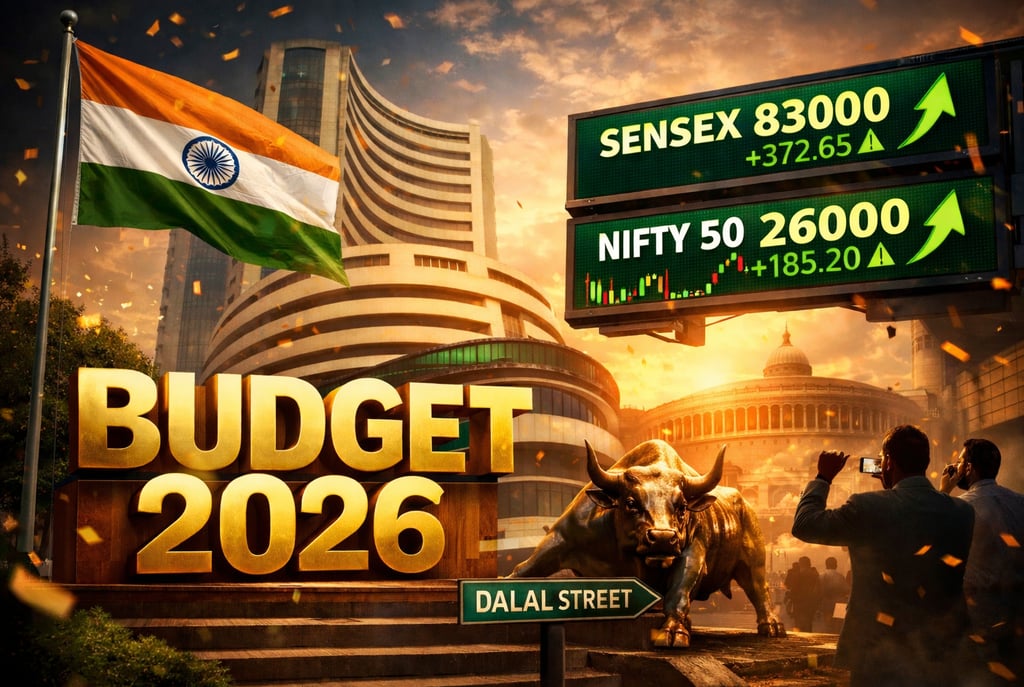
The Indian stock market is all set for a rare and highly anticipated move — trading will take place on Sunday, February 1, as the Government of India presents the Union Budget. For market participants, this is not just another trading day; it’s a once-a-year opportunity that often sets the direction of the markets for months ahead.
Sunday trading sessions linked to the Budget are uncommon, but when they happen, they bring high volatility, massive volumes, and decisive trends. From retail investors to institutional giants, everyone keeps their eyes glued to Dalal Street.
Let’s break down why the Indian market is opening on Sunday, what usually happens on Budget Day, and how investors and traders should prepare.
Why Is the Indian Market Open on Sunday?
Normally, the NSE and BSE remain closed on weekends. However, when Budget Day falls on a weekend, exchanges open for a special live trading session to ensure real-time price discovery and transparency.
The Union Budget is one of the most market-sensitive events of the year. Opening the market on Budget Day allows:
Immediate reaction to policy announcements
Fair valuation of stocks and sectors
Smooth price discovery without panic gaps on Monday
In simple terms, markets move with the Budget, not after it.
What Makes Budget Day So Important for Markets?
The Union Budget directly influences:
Taxation (capital gains, income tax slabs, GST)
Government spending and fiscal deficit
Infrastructure and capex allocation
Sector-specific incentives
This is why Sensex, Nifty 50, Bank Nifty, and sectoral indices often witness sharp moves on Budget Day.
Historically, Budget sessions have seen:
Intraday swings of 2–4%
Heavy activity in banking, infra, PSU, FMCG, IT, and capital goods stocks
Sudden trend changes based on policy clarity
What Will Investors Be Watching Closely?
On Sunday, February 1, market participants will track:
1. Fiscal Discipline
Any signal of higher fiscal deficit can worry markets, while controlled spending boosts confidence.
2. Capital Market Taxation
Even a small tweak in capital gains tax, STT, or securities taxation can move markets sharply.
3. Infrastructure Push
Higher capex allocation benefits stocks in construction, cement, steel, railways, and power.
4. Banking & Credit Growth
Announcements related to PSU banks, credit guarantees, or liquidity support are key for Bank Nifty.
5. Retail & Consumption Boost
Relief for middle-class taxpayers can drive FMCG, auto, and retail stocks.
How Markets Typically Behave on Budget Day
Budget Day trading is not for the faint-hearted.
Pre-Budget Session: Markets often stay range-bound as traders avoid big positions.
During Speech: Sudden spikes and crashes are common; algo trading dominates.
Post-Speech: The real trend emerges once numbers and fine print are analyzed.
Many times, the first reaction is emotional, while the second reaction is rational.
What Should Retail Investors Do?
If you are a long-term investor, Budget Day should not trigger panic.
Smart strategies include:
Avoiding impulsive buying or selling
Focusing on fundamentally strong stocks
Using volatility to accumulate quality names gradually
Remember, good budgets create trends, not instant wealth.
What About Traders?
For traders, Sunday’s session is all about risk management.
Keep position sizes small
Use strict stop losses
Avoid over-leveraging
Expect sudden whipsaws
Options traders should be extra cautious, as IV crush and wild premiums are common on Budget Day.
Key Takeaway: Opportunity with Responsibility
The Indian market opening on Sunday, February 1, due to the Union Budget, is a big event for Dalal Street. It reflects India’s growing financial maturity and commitment to transparency.
While the Budget can create short-term volatility, its true impact unfolds over the next few quarters through earnings, growth, and reforms.
For investors, this Sunday is not about excitement — it’s about strategy, patience, and perspective.
Disclaimer: This article is for educational purposes only and not investment advice. Market investments are subject to risk.
Contact
Reach out for insights or support
Phone
hello@bullsin.com
+1-555-789-1234
© 2025. All rights reserved.
www.bullsin47@gmail.com