

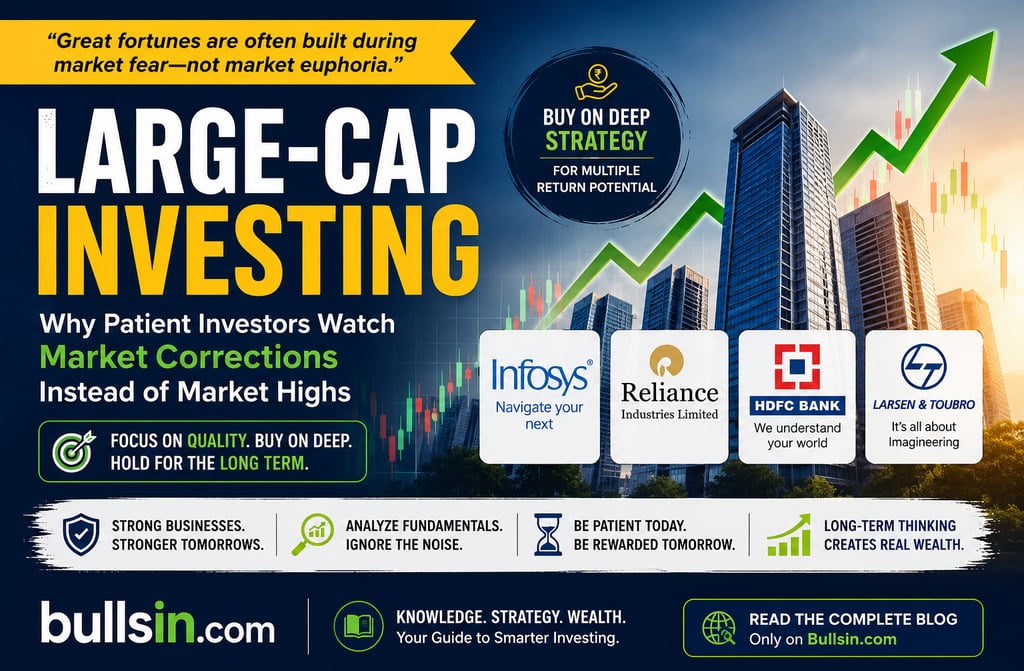
Large-Cap Investing: Why Patient Investors Watch Market Corrections Instead of Market Highs
Large-Cap Investing: Why Patient Investors Watch Market Corrections Instead of Market Highs, Focus On under value Large cap Market Leader So Risk rewards is Favourable.
bulls in
7/1/20263 min read
Large-Cap Investing: Why Patient Investors Watch Market Corrections Instead of Market Highs
Introduction
Every investor dreams of buying a great company before it becomes significantly more valuable. Yet, many people make the same mistake—they chase stocks when prices are already soaring and panic when markets decline.
History suggests that some of the world's most successful investors have taken a different approach. Instead of fearing corrections, they view periods of market weakness as opportunities to study fundamentally strong businesses that may become available at more attractive valuations.
Large-cap companies often attract attention because they generally have established business models, diversified operations, experienced management teams, and stronger balance sheets than many smaller firms. While no stock is guaranteed to perform well, these characteristics can make large-cap businesses an important part of a long-term investment portfolio.
This article explores the philosophy of long-term investing during market corrections, how investors evaluate quality companies, and why patience is often considered one of the most valuable investing skills.
Understanding Large-Cap Stocks
Large-cap companies are businesses with substantial market capitalization and an established presence in their industries. These companies often operate across multiple regions, generate consistent revenue, and have long operating histories.
Examples in India include businesses operating in banking, information technology, energy, infrastructure, consumer goods, and pharmaceuticals.
Many investors are drawn to large-cap companies because they may offer:
Relatively stable business models
Greater liquidity
Strong corporate governance (though this should always be assessed individually)
Broader analyst coverage
Potential for long-term compounding, although future performance is never guaranteed
It's important to remember that even high-quality companies can experience periods of underperformance, and past success does not ensure future returns.
Why Market Corrections Matter
A market correction is typically defined as a meaningful decline from recent highs. Corrections can be triggered by economic uncertainty, geopolitical events, changes in interest rates, company-specific news, or shifts in investor sentiment.
Although corrections can feel uncomfortable, they also encourage investors to reassess valuations rather than simply following momentum.
Rather than asking, "How much has the stock fallen?" many experienced investors ask:
Has the underlying business changed?
Are earnings expectations still reasonable?
Is the company's competitive position intact?
Has the decline been driven more by sentiment than fundamentals?
These questions help separate short-term price movements from long-term business value.
Buying Businesses, Not Just Stock Prices
One of the most common investing mistakes is focusing only on a stock's price.
A lower share price does not automatically mean a company is a good investment. Likewise, a higher price does not necessarily mean a company is overvalued.
Successful long-term investors often begin by evaluating the business itself:
Revenue Growth
Is the company growing consistently over time?
Profitability
Does it generate healthy and sustainable profits?
Cash Flow
Is the business producing strong operating cash flow?
Debt Levels
Can it comfortably manage its debt obligations?
Competitive Advantage
Does the company have durable strengths such as brand recognition, technology, distribution, or cost leadership?
Only after understanding these factors do many investors consider valuation.
Why Patience Can Be an Investor's Advantage
Markets move in cycles.
There are periods of optimism, fear, uncertainty, and recovery.
Investors who react emotionally to every headline may find it difficult to maintain a consistent strategy.
Patience does not mean ignoring risks. Instead, it means making decisions based on research rather than short-term market noise.
Long-term investing often involves accepting that volatility is a normal part of equity markets.
Quality Matters More Than Popularity
A stock becoming popular on social media does not necessarily make it a good investment.
Similarly, a temporary decline does not automatically make a company attractive.
Investors often evaluate quality through factors such as:
Consistent earnings
Strong management execution
Healthy return on equity
Sustainable competitive advantages
Sensible capital allocation
Reasonable valuation relative to fundamentals
These characteristics can help investors compare businesses more effectively, though they should always be considered alongside broader market and economic conditions.
Illustrative Examples of Large-Cap Companies
Indian markets include several well-known large-cap businesses across different sectors. For example:
Infosys in information technology
Reliance Industries across energy, retail, and telecommunications
HDFC Bank in financial services
Larsen & Toubro in engineering and infrastructure
These companies are often discussed by investors because of their scale and business history. However, mentioning them here is for educational purposes only and should not be interpreted as a recommendation to buy or sell any security.
The Psychology of Buying During Fear
One of the hardest aspects of investing is controlling emotions.
When markets are rising rapidly, investors often experience fear of missing out (FOMO).
When markets decline, they may experience fear of further losses.
Long-term investing requires balancing these emotions with disciplined research.
Rather than reacting to daily price swings, investors may benefit from focusing on business fundamentals, valuation, and their own financial goals.
Key Takeaways
Large-cap companies often represent established businesses, but they still carry investment risk.
Market corrections can create opportunities to review quality companies at potentially more attractive valuations.
Strong businesses should be evaluated based on fundamentals, not just price movements.
Diversification, patience, and disciplined research remain important principles for long-term investing.
No investment strategy guarantees profits, and every investment decision should align with an individual's financial circumstances and risk tolerance.
Contact
Reach out for insights or support
Phone
hello@bullsin.com
+1-555-789-1234
© 2025. All rights reserved.
www.bullsin47@gmail.com