

Why the U.S. Stock Market Keeps New Highs Despite Global Volatility:Bull Run After Trump's Return
Why the U.S. Stock Market Keeps New Highs Despite Global Volatility. Learn how AI, corporate earnings, interest rates, and economic policies are shaping the U.S. stock market in 2026.
Bullsin.com
7/4/20265 min read
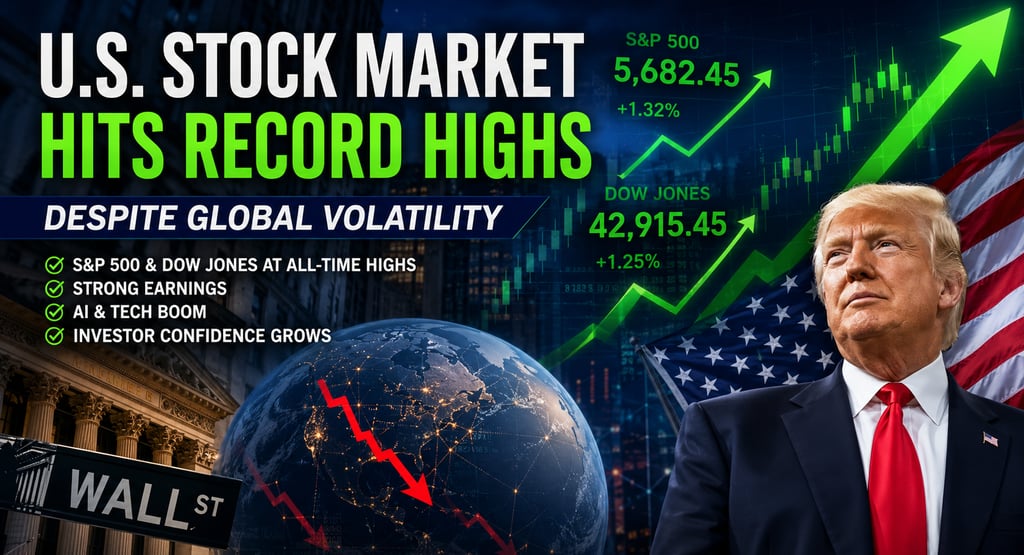
Why the U.S. Stock Market Keeps Reaching New Highs Despite Global Volatility
Global financial markets have experienced significant volatility over the past two years. Rising geopolitical tensions, inflation concerns, trade disputes, and fluctuating interest-rate expectations have created uncertainty for investors worldwide. Yet, in the middle of this uncertainty, one market has continued to demonstrate remarkable resilience—the United States.
The S&P 500 and the Dow Jones Industrial Average have repeatedly touched new record highs, surprising many investors who expected prolonged market weakness. For beginners, this may seem contradictory. How can markets rise when headlines are filled with uncertainty?
The answer lies in understanding that stock markets look forward rather than backward. Investors price future earnings, innovation, and economic expectations instead of reacting only to current events.
One factor that attracted attention was Donald Trump's return to the White House. Investors anticipated a business-friendly administration with policies supporting lower corporate taxes, deregulation, domestic manufacturing, and infrastructure investment. Such expectations generally improve investor confidence because businesses may retain more profits and expand operations.
However, attributing the entire market rally to politics would be misleading. The U.S. market's strength is the result of several powerful economic forces working together.
1. Artificial Intelligence Has Become the Largest Growth Engine
Artificial Intelligence has transformed from a promising technology into one of the world's most important investment themes.
Technology companies investing heavily in AI infrastructure, cloud computing, semiconductor manufacturing, and enterprise software have delivered strong revenue growth and exceeded market expectations. Businesses across healthcare, finance, manufacturing, retail, education, and cybersecurity continue adopting AI solutions to improve productivity and reduce costs.
As earnings from leading technology companies accelerated, investor confidence increased dramatically, lifting major indices higher.
Rather than being a short-term trend, AI is increasingly viewed as the next industrial revolution, encouraging institutional investors to allocate more capital toward technology leaders.
2. Corporate Earnings Continue to Surprise Investors
Ultimately, stock prices follow profits.
Many large U.S. companies have consistently reported stronger-than-expected quarterly earnings despite economic uncertainty. Businesses have adapted through cost optimization, automation, supply-chain diversification, and digital transformation.
When companies earn more money than analysts expect, investors are willing to pay higher valuations, pushing stock prices upward.
Strong earnings growth has become one of the biggest reasons the S&P 500 continues setting new records.
3. The U.S. Economy Has Remained More Resilient Than Expected
Many economists predicted a deep recession following aggressive interest-rate hikes. Instead, the U.S. economy demonstrated remarkable resilience.
Consumer spending remained healthy, unemployment stayed relatively low, and business investment continued across multiple industries.
This economic strength reassured investors that America could sustain long-term growth even while other economies struggled with slower expansion.
Confidence in economic stability often translates directly into higher stock market valuations.
4. Expectations Around Interest Rates
Interest rates significantly influence equity markets.
As inflation gradually moderated, investors increasingly believed that the Federal Reserve would eventually slow or reverse its tightening cycle.
Lower expected interest rates reduce borrowing costs for businesses, encourage investment, and generally increase the attractiveness of stocks compared with fixed-income assets.
Markets often rise months before actual rate cuts because investors anticipate future policy changes rather than waiting for official announcements.
5. Trump's Economic Agenda and Market Sentiment
Following Donald Trump's return to office, investors closely watched his administration's economic priorities. Policies emphasizing tax competitiveness, domestic manufacturing, infrastructure investment, and reducing certain business regulations were viewed by many market participants as supportive of corporate profitability.
At the same time, investors also remained aware of potential risks, including tariffs, trade tensions, and higher government borrowing. These policies can benefit some industries while creating challenges for others. As a result, market performance has varied across sectors rather than moving uniformly.
This highlights an important lesson for investors: political developments can influence short-term market sentiment, but long-term stock performance is still driven primarily by corporate earnings, innovation, productivity, and economic growth.
6. Why Global Volatility Hasn't Stopped the U.S. Market
Conflicts, geopolitical tensions, inflation concerns, and slowing growth in several economies have created uncertainty across global markets. Despite these challenges, the U.S. market has continued to attract capital from investors around the world.
There are several reasons for this:
The United States remains home to many of the world's largest and most profitable companies.
The U.S. dollar continues to play a central role in the global financial system.
American companies lead in technology, artificial intelligence, healthcare, aerospace, and financial services.
Institutional investors often view U.S. equities as a relatively stable long-term investment during periods of global uncertainty.
Because of these strengths, international investors frequently increase their exposure to U.S. stocks when economic conditions elsewhere become less predictable.
7. Risks Investors Should Not Ignore
Although the long-term outlook remains constructive, no bull market moves upward in a straight line.
Investors should continue monitoring:
Inflation trends
Federal Reserve interest-rate decisions
Corporate earnings growth
Global trade policies
Geopolitical conflicts
Government debt levels
Technology-sector valuations
Temporary corrections are a normal part of healthy markets. Experienced investors often view such pullbacks as opportunities to accumulate quality companies rather than reasons to panic.
Investment Lessons for Long-Term Investors
History consistently shows that successful investing is built on patience and discipline rather than attempting to predict every market movement.
Some practical principles include:
Invest regularly through systematic investing.
Focus on businesses with strong earnings and durable competitive advantages.
Diversify across sectors instead of relying on a single industry.
Avoid emotional decisions driven by daily news headlines.
Maintain a long-term perspective, especially during periods of volatility.
For many investors, wealth is created not by perfectly timing the market but by remaining invested in high-quality companies over many years.
Final Thoughts
The continued rise of the S&P 500 and Dow Jones despite global uncertainty demonstrates the resilience of the U.S. economy and the strength of its corporate sector. While political leadership, including President Donald Trump's policies, can influence investor confidence, the market's long-term direction depends on a broader combination of innovation, corporate profitability, consumer demand, productivity, and economic fundamentals.
Artificial intelligence, digital transformation, resilient businesses, and continued investment in innovation remain among the most significant drivers of the current bull market. At the same time, investors should remain disciplined, diversified, and prepared for periods of market volatility.
Rather than reacting to every headline, successful investors focus on long-term fundamentals and allow time and compounding to work in their favor.
Frequently Asked Questions (FAQs)
Why is the U.S. stock market rising despite global uncertainty?
The market is supported by strong corporate earnings, leadership in artificial intelligence, resilient consumer spending, continued innovation, and investor confidence in the long-term strength of the U.S. economy.
Is Trump's presidency the only reason the market is reaching record highs?
No. While policy expectations may influence market sentiment, stock prices are also driven by company earnings, technological innovation, interest-rate expectations, productivity, and overall economic performance.
Should investors buy during market volatility?
Volatility is a normal feature of financial markets. Investors should evaluate their financial goals, risk tolerance, and investment horizon before making decisions rather than reacting emotionally to short-term price movements.
Which sectors may benefit over the long term?
Technology, artificial intelligence, semiconductor manufacturing, healthcare, cybersecurity, cloud computing, financial services, and infrastructure-related industries continue to attract significant investor interest, although future performance is never guaranteed.
Disclaimer: This article is for educational and informational purposes only and should not be considered financial or investment advice. All investments involve risk, including the potential loss of principal. Readers should conduct their own research or consult a qualified financial advisor before making investment decisions.
Contact
Reach out for insights or support
Phone
hello@bullsin.com
+1-555-789-1234
© 2025. All rights reserved.
www.bullsin47@gmail.com